


Demon Tiles Geometry Songs 2.2
3.323.00 Reviews
App Specs
- Version
- 2.1.3
- Updated On
- License
- Free
- Downloads
- 100,000+
- Developer
- BOOT-DARK
- Categories
- Music
- Platform
- Android
Screenshots
 Analysis by AppCompare
Demon Tiles Geometry Songs 2.2 is the kind of music game that makes sense when I want a quick distraction rather than a large, demanding game to learn. It belongs to the music category, comes from BOOT-DARK, and is free to play. The basic appeal is immediate: choose a level, follow the visual rhythm, and try to stay connected to the song without losing concentration.
That simple setup is also the central question for me. A game like this can be enjoyable during the first few sessions, but its lasting value depends on whether the levels and songs continue to feel satisfying after the novelty disappears. I spent time looking at it from that angle rather than judging it only by its first impression. My conclusion is fairly clear: it can earn a place on an Android device for players who enjoy short rhythm challenges, but it is less convincing for anyone looking for deep progression, a large social layer, or a music game that becomes a long-term daily habit.
What the first sessions feel like
The first-week appeal comes from how little preparation the game seems to require. I do not need to understand a complicated story or learn a large control system before reaching the main activity. The focus is on levels and their songs, so the game gets to its musical challenge quickly. That makes it suitable for a spare moment before work, during a break, or while waiting for an appointment.
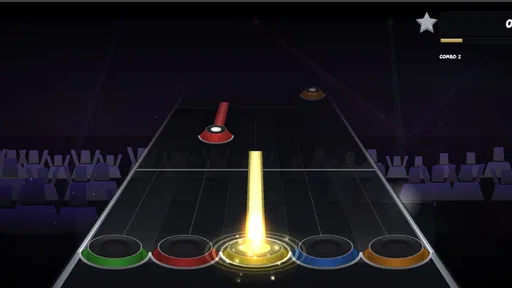
The visual presentation is built around a dark, energetic style suggested by the name and the geometric theme. That gives the game a distinct identity instead of making it look like a plain audio player with a score attached. The combination of shapes, movement, and timing creates the right kind of pressure for a rhythm title: I am watching what is happening while listening for the pattern that tells me when to react.
What I like most at the beginning is the low commitment. I can try a level without promising myself a long session. If I make a mistake or lose focus, the experience is easy to put down and revisit later. This is an important strength because music games often work best when they fit naturally into small gaps in the day rather than demanding a full evening.
There is also a useful psychological loop in replaying a level. The first attempt is usually about understanding the song and the visual movement. A later attempt is about correcting the moment where I hesitated. That difference gives the game more substance than a one-time pass through each stage. Even when I do not improve dramatically, I can feel that the challenge is asking for attention rather than simply handing me a passive soundtrack.
For a realistic everyday example, I could open it after finishing a short task at home, play one or two levels, and close it before the session starts to feel like work. That use case suits the game well. It is less suitable when I want something relaxing in the background, because the music and visual cues are tied to active concentration. I need to look at the screen and respond; this is not a game I would recommend playing while walking, cooking, or doing anything else that divides attention.
Worth Reading Before You Choose

Flipboard Shows What News Apps Must Do Beyond the Feed

Switching to Android Auto Means Rethinking Your Driving Routine

Google Calendar Makes a Crowded Week Easier to Manage

Ludo King Makes the Most of the Minutes Between Plans

Baby Panda World Brings Quick Play to Modern Phones, but Its Game Library Feels Busy

ESPN’s Live Game View Makes Following Close Games Easier
Learning the rhythm without overthinking it
My practical advice is to resist trying to master every level immediately. During the first play, I would treat the song as a lesson: notice how the visual geometry moves, identify where the rhythm becomes denser, and accept that an imperfect run is useful. On the second attempt, I would focus on one troublesome passage instead of chasing a flawless result from the opening seconds.
This approach matters because music games can become frustrating when I interpret every mistake as a failure. In this one, a missed section can instead reveal how the level is organized. I found that listening for recurring musical accents was more helpful than staring only at the shapes. The screen tells me what is coming, but the song helps me anticipate it.
The short description, “Demon Tiles,” is much less informative than the actual experience. The game is not best understood as a broad music library or a general-purpose audio app. It is a focused game built around playing through levels connected to songs. That distinction is important for anyone deciding between this and a music streaming service, where the main purpose is listening rather than interaction.
Who will enjoy the opening most
I would point this toward players who like arcade-style rhythm games, quick retries, and visual patterns that demand concentration. It may also work for someone who wants a free game with a straightforward premise and does not want to spend time managing a large collection of characters, equipment, or story missions.
It is a weaker match for players who need a strong narrative reason to continue, competitive multiplayer, or extensive customization. Those expectations can make the initial simplicity feel more like a limitation than a benefit. A player who normally prefers large progression systems may enjoy the first sessions but quickly ask what new purpose each replay serves.
Does it keep its value after the novelty fades?
The month-to-month question is harder. The first attraction is easy to understand, but recurring value depends on how often I genuinely want to return to the same kind of challenge. Since the core activity remains centered on levels and songs, the game’s long-term appeal comes mainly from improving timing, revisiting favorite tracks, and fitting short sessions into a routine.
That can be enough for a certain type of player. Rhythm games do not always need a complicated reward structure to stay interesting. If I enjoy gradually becoming more accurate, a familiar level can remain worthwhile because my relationship with it changes. I notice different transitions, react earlier, and make fewer impulsive movements. The pleasure comes from refinement rather than discovery.
However, that kind of value is personal and skill-based. It is not the same as receiving a steady stream of new reasons to play. If I need constant novelty, I may feel the available material more sharply over time. A game that depends on repeating songs has to make those repetitions feel intentional. Once I know a level well, the question becomes whether improving my performance is satisfying enough on its own.
For me, the best way to keep it useful would be to give it a specific role in a weekly routine. I might use it for a few focused sessions instead of opening it automatically whenever I am bored. That prevents the game from becoming background noise and gives each return a clear purpose: warming up, beating a previous result, or simply playing a favorite song after a stressful day.
This is one of the less obvious trade-offs. Playing more often does not automatically create more value. With a rhythm game, excessive repetition can reduce sensitivity to the music and turn the experience into mechanical tapping. Shorter, intentional sessions may preserve enjoyment better than trying to grind through the same content every day.
How it compares with familiar alternatives
Compared with a music streaming app, this game offers participation instead of passive listening. I cannot treat it as a replacement for a playlist, because the appeal depends on interacting with the song and the visual challenge. If I want to discover artists, control a long queue, or listen while the screen is off, a streaming service is clearly the better choice.
Compared with larger rhythm games, its advantage is approachability. A bigger competitor may offer more elaborate progression, broader presentation, or a stronger sense of collection and achievement, but that can also bring more menus and more obligations. This game is easier to understand as a compact challenge. I would choose it when I want the musical action without building a large in-game routine around it.
That simplicity has a limit, though. Players who stay motivated through unlockable systems, events, rankings, or a deep personal profile may find a more feature-heavy alternative more rewarding over several months. I would not choose this title solely because it is free; I would choose it because the focused format matches the way I want to play.
What maintenance really means here
There is no complicated maintenance routine that I would need to perform before every session. The real burden is attention. I have to keep the display visible, listen carefully, and accept that improvement requires repeating sections instead of simply moving forward. That is light compared with a large live-service game, but it is still a commitment.
The practical device requirements are modest in the sense that the game supports Android from version 5.0 onward. It is therefore aimed at a broad range of Android devices rather than only recent phones. Still, compatibility alone does not guarantee that every screen, speaker, or touch response will feel equally comfortable. Rhythm games are especially sensitive to timing, so I would test it on my own phone and avoid judging the experience from specifications alone.
Sound setup also matters more than many new players expect. I would begin with a comfortable volume and use a quiet environment when learning a difficult level. If the surroundings are noisy, I may rely too heavily on the visual movement and lose the musical cues that make the game feel fair. This is a concrete reason to play it at a desk or during a calm break rather than in a crowded place.
Another useful habit is to stop after a frustrating run instead of immediately repeating it again and again. Fatigue can make a timing problem look like a control problem. A short pause often tells me whether I actually need more practice or whether I am simply no longer paying attention. That small adjustment can make the game feel more consistent and less punishing.
Where repeated play starts to wear thin
The main source of fatigue is repetition without a fresh personal goal. If I replay a level only because I feel I should finish it, the music can lose its charm. The same pattern that felt exciting during the first week may feel predictable later. That is not necessarily a flaw in the game; it is a natural risk for any focused rhythm title. But it does mean the game rewards players who enjoy mastery more than players who need constant surprise.
A second source of fatigue is the gap between listening and reacting. I may like a song but still dislike playing its level if the visual demands interrupt the way I want to hear it. Conversely, a level can be enjoyable as a challenge even when the song itself is not one I would choose casually. The game asks me to judge both layers at once, and they will not always agree.
There is also the possibility of uneven motivation from one session to the next. On a day when I want concentration, the geometric movement can be engaging. On a day when I want something gentle, the same activity can feel demanding. I would not describe it as an all-purpose comfort game. Its best mood is alert, focused, and slightly competitive with myself.
The public response gives a useful warning without deciding the matter for everyone: the game has an average rating of 3.3 from around nine hundred ratings. I read that as a sign to keep expectations measured. It has found an audience, with more than one hundred thousand installs, but it is not a universal recommendation. The rating suggests that the straightforward concept will appeal strongly to some players while leaving others wanting a smoother or deeper experience.
That context changes how I would recommend it to a friend. I would say, “Try it if you already enjoy music games and want a free, compact option,” rather than promising a definitive rhythm-game experience. The distinction is important. A trial makes sense because the core appeal is easy to understand quickly, while the long-term question depends heavily on personal tolerance for repetition.
Version, age suitability, and practical expectations
The current version is 2.1.3, and the game is rated for Everyone. That makes it approachable from an age-rating perspective, although younger players may still need sensible screen-time limits because rhythm challenges can encourage repeated attempts. I would also keep the volume comfortable, particularly when children are playing for longer sessions.
Because it is free, the entry decision is simple: there is no purchase barrier to discovering whether the timing and visual style suit me. Free access does not remove the opportunity cost, though. My time is still the resource being spent, and a game that does not hold my attention after a few sessions may not deserve permanent space on the device.
The developer, BOOT-DARK, has given the game a clear niche rather than presenting it as a general entertainment package. I appreciate that focus, but it also makes the experience easier to evaluate. If the central rhythm loop works for me, the game has a reason to stay installed. If it does not, there are not many unrelated activities inside it that might compensate.
My long-term verdict
After the first-week excitement fades, I see Demon Tiles Geometry Songs 2.2 as a compact rhythm game with conditional staying power. Its strongest quality is the direct connection between song, movement, and replay. It is easy to pick up, suitable for short sessions, and free to try on an Android device that meets its minimum operating-system requirement.
Its weakness is the same simplicity that makes it approachable. The experience may not provide enough variety for players who expect a deep progression system or a constant supply of new incentives. Repetition can become tiring, and the game demands active attention rather than functioning as a relaxed music companion. Those are not minor details; they should determine whether it remains installed.
I would keep it for a month if I enjoyed improving at individual levels and had a regular place for focused, five-minute-style sessions. I would remove it if I found myself replaying without a goal, ignoring the music, or opening it only from habit. That is my clearest maintenance test: does each return feel like a deliberate musical challenge, or am I simply filling time?
My recommendation is cautious but positive. Try it if you want a free music game with an immediate premise, geometric visual energy, and room to improve through repetition. Skip it if your ideal alternative is a large, constantly expanding rhythm platform or a passive listening app. It earns lasting space for a player who values compact mastery, but it does not automatically become a permanent daily game just because the first sessions are engaging.
Pros
- Simple tap-based gameplay that is easy to learn quickly.
- Geometry-themed visuals give the game a distinctive style.
- Song-based levels can make short play sessions feel engaging.
- Suitable for casual players looking for quick entertainment.
- Lightweight design should run well on many mobile devices.
Cons
- Difficulty may increase sharply in later levels.
- Repeated tapping can become monotonous over longer sessions.
- Some songs or levels may feel limited in variety.
- Fast gameplay may be challenging on smaller screens.
- Ads or in-app purchases may interrupt the experience.
FAQs for Demon Tiles Geometry Songs 2.2
What is Demon Tiles Geometry Songs 2.2?
Demon Tiles Geometry Songs 2.2 is a rhythm-based mobile game that combines fast tile tapping with geometric visuals and music-focused gameplay. Players follow songs by tapping, holding, or avoiding tiles in time with the beat. Its appeal comes from short, energetic levels, progressively faster patterns, and a colorful presentation designed for quick sessions on Android devices.
How do you play Demon Tiles Geometry Songs 2.2?
The main objective is to interact with the correct tiles while the music plays and avoid mistakes that can end a run. Timing is especially important because patterns become faster and more complex as the level continues. Before downloading, players should expect a game that rewards concentration, rhythm, and repeated practice rather than slow, relaxed play.
Does Demon Tiles Geometry Songs 2.2 work offline?
Some gameplay may be available without a continuous internet connection, particularly after the necessary game files and songs have been loaded. However, features such as advertisements, updates, online rankings, event content, or additional song downloads may require internet access. Availability can vary by device and version, so checking the app’s current store description is recommended.
Is Demon Tiles Geometry Songs 2.2 free to download?
Demon Tiles Geometry Songs 2.2 may be offered as a free download, but free access does not always mean the entire experience is completely without limitations. Depending on the release, players could encounter advertising, optional purchases, locked content, or extra resources. Review the store listing carefully before installing, especially if you prefer games without ads or in-app payments.
What devices and permissions does Demon Tiles Geometry Songs 2.2 require?
The game’s compatibility depends on the operating system version, available storage, screen performance, and the requirements listed on its official download page. Because rhythm games depend on accurate touch response and smooth audio, older devices may experience lag or sound delay. Check requested permissions before installation and keep enough free space for updates and downloaded game content.


